

How to choose the right school for your child
ทีม FindEdu · 20/05/2026
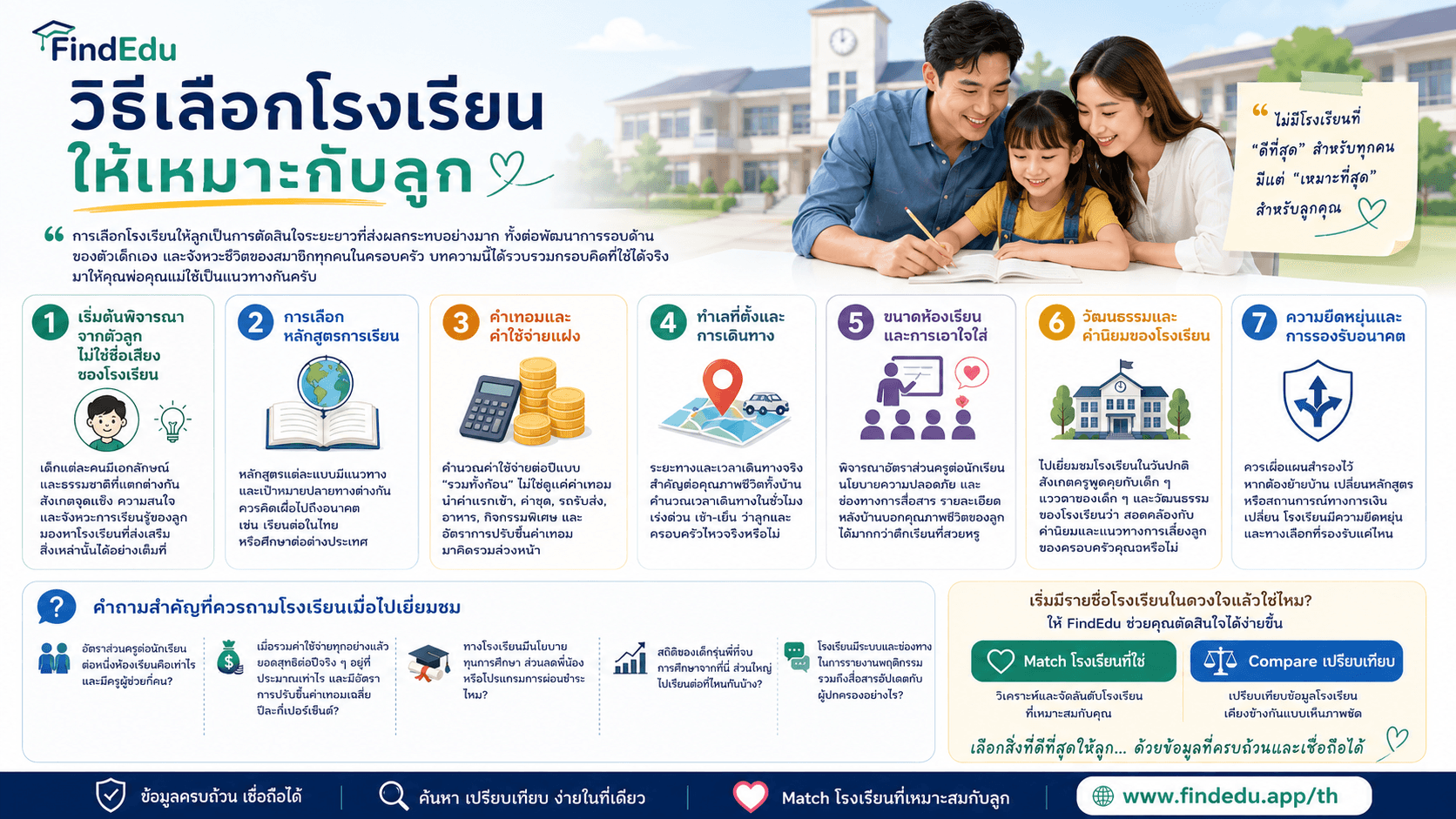
Choosing the right school for your child is a long-term commitment that profoundly shapes both your child's holistic development and the daily rhythm of the entire family. In reality, there is no single universally "best" school; there is only the school that is the "best fit" for your child's unique personality and your family's specific context. This article provides a practical framework to guide you through this critical decision.
1. Start with the Child, Not the School's Reputation
Every child is born with unique strengths, interests, and their own learning pace. Some thrive in highly structured environments, while others learn best through hands-on, creative exploration (Active Learning). First, identify who your child is and how they interact with the world, then look for a school environment that nurtures and celebrates those specific traits.
2. Choosing the Right Curriculum
Whether it is the National Thai Program, a Bilingual Program (EP/MEP), or an International Curriculum (such as British, American, or IB), each pathway has distinct teaching methodologies and distinct destinations. Think ahead to higher education—whether you envision your child studying in Thailand or going abroad—and select a foundational curriculum that aligns with that ultimate goal.
3. Tuition Fees and Hidden Costs
Financial sustainability is key to family happiness. When budgeting, look at the "all-inclusive cost" per academic year, rather than just the base tuition fee printed on the flyer. Be sure to factor in one-time enrollment fees, uniforms, textbooks, mandatory bus transportation, meal plans, extra activities, and compound annual tuition hikes.
4. Location and Daily Commute
An extraordinary, top-tier school can quickly become a source of daily exhaustion if it is located too far away. Heavy commutes drain a child's energy and compromise the family's quality of life. Evaluate the actual travel time during peak rush hours, rather than relying solely on the physical distance shown on a digital map.
5. Class Size and Pastoral Care
Pay close attention to the teacher-to-student ratio within the classroom, the school's safety protocols, and how effectively they handle pastoral care. The way a school manages its student well-being and maintains communication with parents tells you far more about its quality than modern, fancy campus buildings.
6. School Culture and Shared Values
Whenever possible, arrange a physical visit to the campus on a regular school day. Observe how the teachers talk to the children when they think no one is watching, and check if the students look genuinely happy and engaged. Ensure the school’s core values and social culture resonate with your family's parenting philosophy.
7. Future Flexibility
Life can be unpredictable. Consider how adaptable the school path is if your family ever faces sudden changes, such as relocating, needing to switch curricula, or experiencing unexpected economic shifts. A good school pathway should offer reasonable flexibility for your family's future.
Essential Questions to Ask During Your School Visit
- What is the exact teacher-to-student ratio per class, and are there full-time teaching assistants?
- What is the absolute all-inclusive cost per year, and what is the school's historical average for annual tuition increases?
- Does the school offer sibling discounts, scholarships, or flexible financial payment plans?
- Where do graduates from previous cohorts typically continue their higher education?
- What channels and systems does the school use to communicate regular updates or behavioral progress to parents?
Once you have a shortlist of potential schools in mind, try using our FindEdu Match feature to evaluate and rank them based on your personalized criteria, or bring them together to Compare side-by-side to make your final choice with complete confidence.